Stripe's Lighthouse Hiring pattern.
I did a lot of hiring at Uber, some days I would be doing back-to-back 30 minute phone screens for several hours in a row. That said, while Uber taught me how to hire at scale, it was Stripe that taught me how to hire creatively.
Some of that was learning the fundamental mechanics like how to cold source, optimizing hiring funnels, and designing interview loops, but Stripe had some fairly unique ideas that I haven’t heard discussed much elsewhere. One of those was Stripe’s Bring Your Own Team (BYOT) concept, which invited teams to apply together as a sort of light-weight acquihire approach.
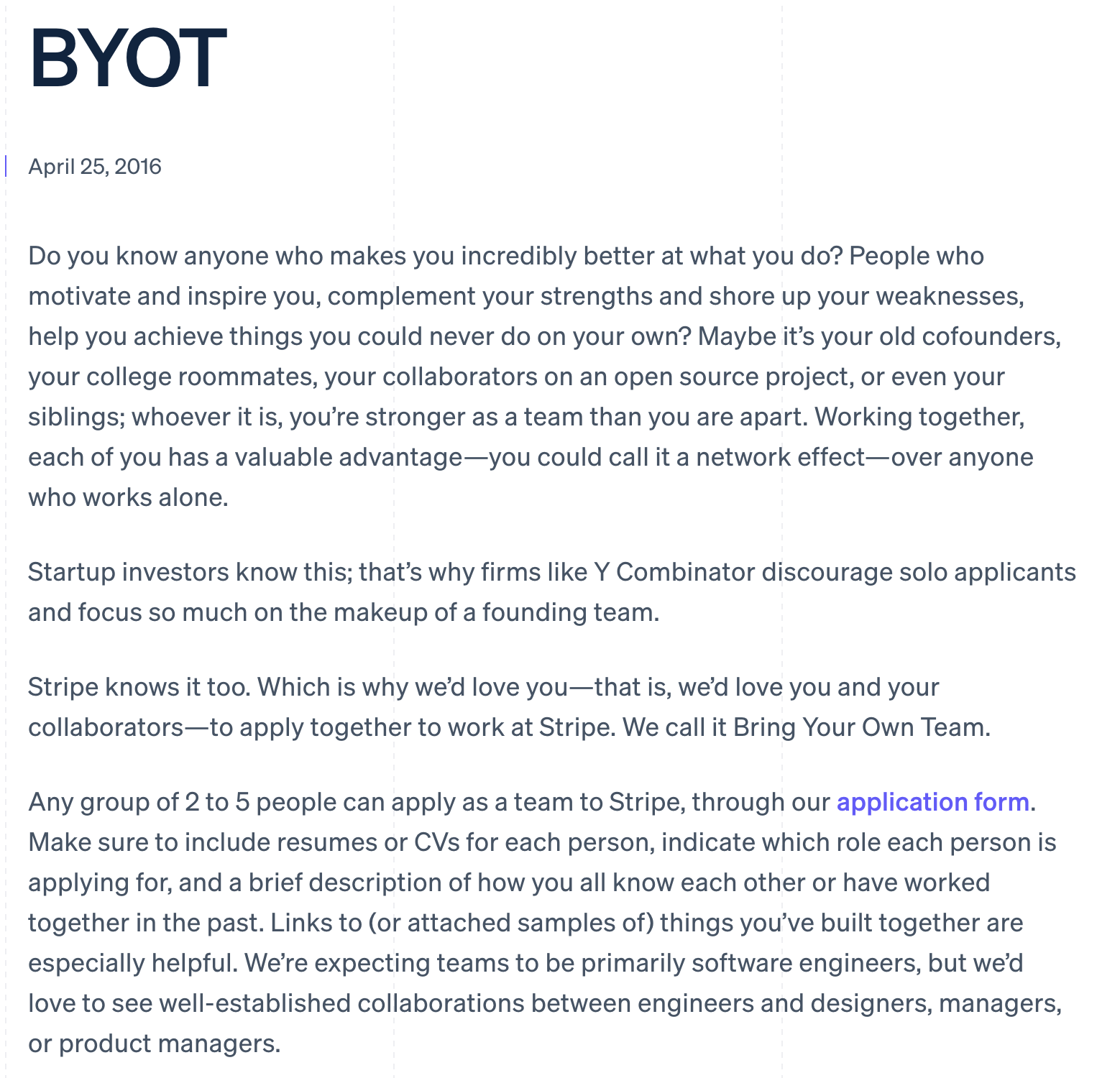
The BYOT approach captured folks’ attention, but it was ultimately more effective as an idea showing Stripe’s originality rather than as a hiring practice. By the point that I left, zero teams had been hired through the BYOT mechanism, although we did talk to some. On the other hand, one of the hiring ideas that Stripe didn’t blog about publicly, but worked extremely well in practice, is the idea of Lighthouse Hiring.
Lighthouse Hiring is the idea that hiring well-connected folks makes subsequent hires both easier and higher quality. Sure, hiring those well-known folks is difficult, but if you’re trying to hire ten great people, then spending more time hiring one “lighthouse hire” can improve the quality and velocity of the overall hiring push.
A few examples of Stripe’s lighthouse hiring:
- Julia Evans is one of the best known tech writers, undoubtedly the best known tech zine artist, and a prolific organizer of interesting projects and conferences. Julia’s presence at Stripe was a core piece of my cold sourcing email for years
- Avi Bryant, who wrote the BYOT blog post, was a well-known and well-connected data engineer, and was the connection point to many Stripe hires from both data ecosystem and out of Twitter
- Raylene Yung was an early engineering leader at Facebook, and extremely well connected in the tech ecosystem. She was the first contact point for a tremendous number of hires out of Facebook and the broader tech ecosystem
There are many other examples you could pick from, and importantly not all of them are widely-known, just widely-connected. Julia is a tech internet mainstay, but Raylene operated more from personal networks rather than social media networks. Any sort of high quality network can be the underpinning of a successful lighthouse hire.
This mechanism worked exceptionally well, but there is a complex underside to Lighthouse Hires: strong networks, particularly publicly visible networks, create a complex power dynamic that some managers can struggle to navigate. If you’re relying on a public personality, and they get frustrated at work, then your lighthouse hiring strategy is going to implode on you. Similarly, hiring them to begin with can be a challenge if you don’t have an interesting role, but carving out a uniquely interesting role for one hire will come across as biased internally, undermining your relationship with the broader team.
These are all navigable, and I think Stripe would have been less successful if it hadn’t used this pattern, but it takes some nuance to deploy effectively.